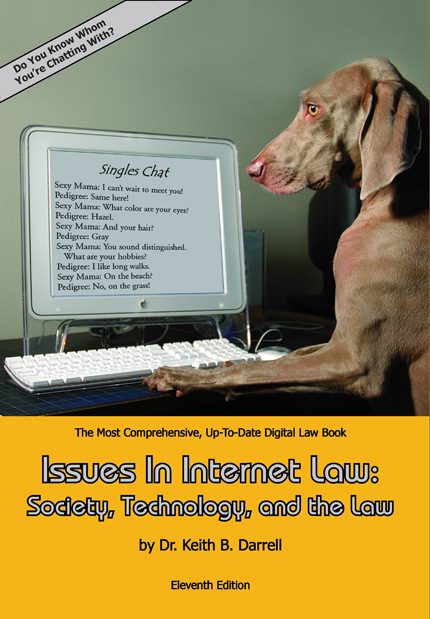
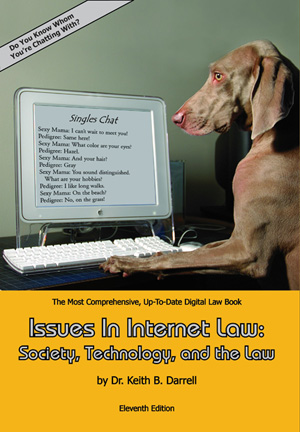
Convergence - a moving together toward a common point. Where does the law end? Where does society's responsibility begin? And what effect does evolving technology have? Advances in technology have always changed societies and there has never been as far-reaching and profound an advance as the Internet. By reaching across all borders into all societies and cultures, the Internet has created a single virtual world - a melting pot where each society's cultures, mores, and values coalesce. The advent of the Internet has raised both legal and sociological issues. Issues In Internet Law: Society, Technology, and the Law is about how rapid technological advances impact society and, in turn, how the law, lagging behind, copes with those changes. This is a view of the law through the prism of society and culture.
Some nations seek to block access to, or filter, online content. Marketers realize the Internet provides unsurpassed access to consumers but such access may entail threats to privacy, manipulation of children, risk of fraud, and undesired annoyances such as spam. The Internet is the world's largest, most pervasive soapbox, where anyone and everyone can have his 15 minutes of fame; but the downside of such unlimited global access is the online megaphone can be used to disseminate misinformation, libel, and hate speech. Laws are required to protect consumers, investors, children, and those defamed or subjected to hate speech. But with hundreds of nations, each with its own jurisprudence, cultural and societal mores, philosophies, and legal systems, which laws will prevail and how could any single nation apply its laws to a technology that knows no boundaries? The Internet, now ubiquitous throughout the world's societies, offers users unlimited communication, but also exposes them to surveillance by their own governments. The scope of an individual's freedom of expression has never been greater, but neither has the encroachment on individual privacy.
The 11th edition of Issues In Internet Law: Society, Technology, and the Law has been updated for 2017 with the latest cases and trends in Internet Law. The new edition not only has an expanded glossary and a full chapter devoted to the NSA's spying on Internet users.
Topics include:
Privacy: Invasion of Privacy, Public Records, Workplace Privacy, Employer & ISP Monitoring, Data Collection, Data Retention, Data Breaches, The Right to be Forgotten, E-Mail & Chat Room Privacy, Web Site Privacy Policies, Behavioral Marketing, Flash Cookies, Device Fingerprinting, Privacy & Children, Metadata, Border Searches, FISA & the USA PATRIOT Act, the NSA, FISA Court, PRISM, XKeyscore, EU Privacy Directives;
Free Speech Defamation, SLAPPs, Gripe Sites, Revenge Porn Sites, Mugshot Sites, Blogs & Vlogs, Obscenity & Pornography, Harassment & Hate Speech, Prior Restraint, Repression, Student Speech, CDA, Anonymous Speech, Commercial Speech, Expressive Conduct; "Fake News";
Social Media: Misuse, Ownership, Coerced Access, the Courts;
Cybercrimes: Ransomware; Spam, Phishing, Identity Theft, Spyware & Malware, Cyberstalking, Cyberbullying, Computer Trespass, Wardriving, Virtual Crime;
Intellectual Property: Copyright, Trademark, Patent, Trade Secrets, Creative Commons, Linking, Framing, File-Sharing, Fair Use, Public Domain, Work-Made-For-Hire, DMCA, VARA, Domain Name Disputes, Keyword Advertising, America Invents Act;
Business & the Internet: Internet Taxation, Internet Interstate Commerce, Web Contracts, e-Discovery, Corporate Securities, Crowdfunding, Reg A, Reg D;
European Union: Directives and Regulations; the General Data Protection Regulation; the Police and Criminal Justice Data Protection Directive; the Privacy Shield;
Also: Cloud Computing; Digital Currency; Right of Publicity; the Internet of Things; Web Accessibility; Net Neutrality; Online Reputation Management; Social Media Monitoring; Podcasts; Geofiltering; Digital Journalism; Hyper Local Web Sites, Digital Estate Planning; Sexting; Facial Recognition; E-Books and many more subjects.